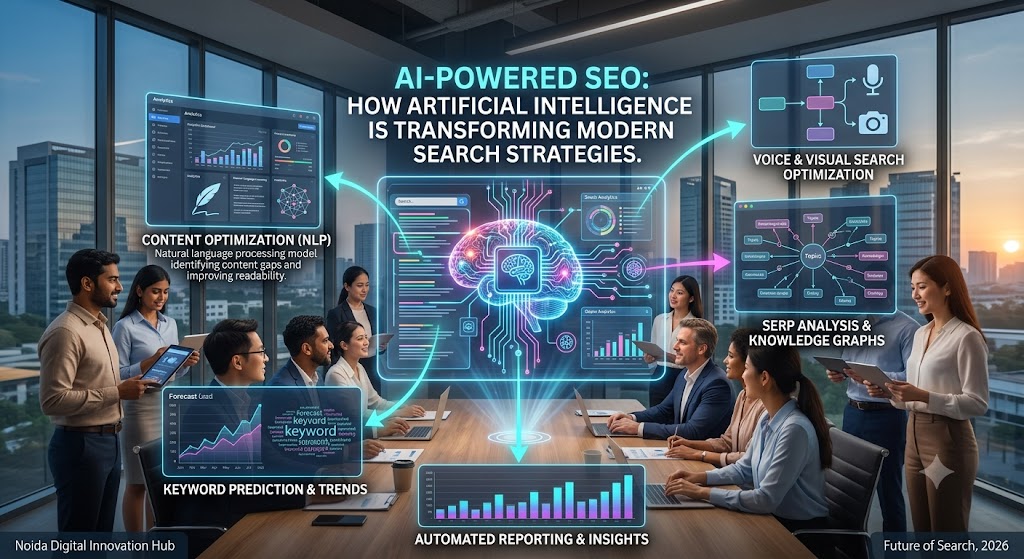

According to Pew Research, six in ten U.S. adults now read AI summaries instead of clicking through to a website. This might lead you to think that SEO is dead. No, it is not. But the search has evolved. Users previously searched for “shoes for wedding,” but now they type “what shoe should I wear with my red gown for my friend’s wedding?”. Search terms are now more specific, more personal, and responses are amazingly relevant.
AI now does the reading for people instead of them having to scroll through links. So ranking on SERPs is not enough. Your brand’s visibility also depends on whether AI systems understand your content well enough to recommend it. That’s the shift driving AI-powered SEO.
This blog will discuss how search has evolved and how AI is rewriting the rules that once worked. Let’s get started.
Understanding AI-Powered SEO
AI-powered SEO doesn’t follow the traditional SEO approach where search means scrolling through ten results and clicking around to find the answer. AI scans multiple sources simultaneously. Then it pulls out what’s relevant and presents one clean answer. In the process, AI cites only a few websites.
The difference between these two approaches is big enough to have a significant impact on citations and rankings. Ahrefs’ latest research backs this, too. This research shows that AI cites valuable pages even if these pages never rank for a single keyword. Then why do these pages get cited by AI? Because they have given AI reliable and necessary information to use and share.
So just ranking in SERPs will not be enough today. Getting cited by AI will help, and that citation can show up in places like:
- Google AI Overviews
- ChatGPT Search
- Perplexity AI
- Microsoft Copilot
- Gemini-powered Search
This shift is transforming how users discover content. When people type keywords to search for something, AI tools now look for content they can trust and confidently cite to those people. This is AI-powered SEO, and it prefers helpful, accurate, and authoritative content that clearly answers users’ questions.
So, in the past, the main question was, “Can Google crawl this page?” Today, the question is, “Would an AI trust this page enough to cite it in its answer?”
Moving Beyond Keywords to Generative Answers
Searching using keywords is still important. But there are some new additions in SEO practices that are totally different from traditional SEO. With Generative Engine Optimization, or GEO, the main goal is to create content that AI can understand, trust, and use in its answers. So, the whole scenario is moving beyond keywords to generative answers.
Another important thing worth mentioning is AEO or Answer Engine Optimization. AEO helps your content appear as direct answers, featured snippets, and voice search results. It is worth remembering that there are differences between GEO and AEO. However, they both work similarly and help make your content more visible in AI-powered search. While GEO helps AI tools find and cite your content, AEO focuses on answering users’ questions directly.
So, if your goal is to rank on the first page of search results, you should also consider getting cited and recommended by AI. One significant way to do this is to create content that provides clear, reliable answers to users’ queries. To better understand this scenario, here is a quick comparison between traditional SEO and GEO.
| Focus Area | Traditional SEO | GEO (Generative Engine Optimization) |
| Key goal | Rank in search results | Get cited in AI generated answers |
| Success metric | Clicks and rankings | Citations, mentions, and AI referral traffic |
| Content style | Keyword optimized content | Clear, well sourced, quotable content |
| Trust signals | Backlinks and domain authority | Third party mentions, reviews, original data |
| important surfaces | Google, Bing search results | AI Overviews, ChatGPT, Perplexity, Gemini |
These approaches differ. But neither GEO nor AEO replace SEO. The wise thing would be to consider GEO to be a layer on top of excellent SEO foundations. AEO already shares this same goal.
Core Pillars of AI-Powered SEO
AI-powered SEOstands on some core pillars. These pillars can improve your visibility and your chances of being cited in AI-generated answers. Here are the core pillars we are talking about.
1. Brand Presence and Mentions
AI will only be able to recommend your brand when it can see your brand. That is why a strong brand presence matters. Building real brand visibility means:
- Checking how you actually show up inside AI tools like ChatGPT, Claude, and Perplexity, not just Google
- Earning mentions in industry blogs, articles and directories
- Creating a genuine and solid presence on PR sites, Reddit, and niche communities
All these build the foundation ofAI-driven search optimization. This ultimately helps AI find, trust, and cite your content.
2. Entity and Authority Signals
AI trusts businesses that are well-known and have strong authority signals. So, to build that trust, you have to
- Strengthen your Wikipedia, Wikidata, and Knowledge Panel presence
- Highlight author expertise, credentials, and genuine reviews
- Earn high-quality backlinks and publish original insights
These are some useful AI SEO strategies for establishing authoritativeness recognized by AI.
3. Content and Passage Optimization
AI prefers relevant and well-structured content. Such content is easy to extract and quote for AI. So, if you want to make your content AI-friendly, you can:
- Lead with clear, direct answers instead of burying them three paragraphs in
- Structure content with Q&A sections, lists, and schema markup like FAQPage or HowTo. This helps AI crawlers understand exactly what a passage means
- Write around entities and concepts. So AI can connect your content semantically to the question being asked
This is where semantic search comes in. This is a practice where AI matches meaning and intent rather than exact phrases, and it’s why passage-level structure now matters as much as page-level SEO.
4. Conversation and Community Coverage
People tend to discover brands through online conversations and communities where they are already in. So, to get noticed and trusted, you have to
- Be active where your audience is. Maybe on platforms like Reddit, forums, and niche communities.
- Use natural, conversational language. Don’t stuff your content with keywords.
- Publish consistently to build trust and make your brand more recognizable over time.
5. Technical Foundations
You must not ignore the technical considerations. A strong technical setup can help If crawlers and AI visit your. So, focus on the basics, such as:
- Access for AI crawlers through a properly configured robots.txt file. Also consider using llms.txt to highlight your most reliable content.
- Responsive website and a clear site structure to improve both user experience and AI crawling.
- Clean and updated XML sitemaps so search engines and AI can easily find your latest content.
6. Visibility Tracking and Adaptation
You can follow modern SEO Strategiesor AI-powered SEO strategies. But you must track how your brand is performing online. It will help you understand what is working and where you are lacking. So keep:
- Tracking mentions and AI share of voice
- Catching shifts and trends early
- An eye on competitor visibility and refining accordingly
These six pillars work closely together. Stronger visibility and credibility increase the chances that AI systems will discover, trust, and reference your content.
The Risk Nobody Is Talking About
Every new practice comes with risks and AI-powered SEO is no exception. AI makes creating and publishing content easier. But it has also made it easier to publish low-quality, inaccurate, or repetitive content. When speed becomes the priority over quality, websites risk losing credibility with both readers and AI-powered search tools.
Publishing a huge number of articles without proper edits and real expertise can increase content output, but it rarely leads to long-term success. Google still values E-E-A-T (Experience, Expertise, Authoritativeness, and Trust). AI tools also prefer content from reliable and trustworthy sources. They don’t value low-quality, generic content that is already available online.
Another challenge is content becoming outdated. Statistics change, prices are updated, and information can become less accurate over time. So, reviewing and updating your content regularly is just as important as creating it.
The takeaway is simple: use AI to create content faster, but rely on real expertise to make your content accurate, helpful, and trustworthy.
How to Build Better SEO Workflows with AI
AI isn’t simply disrupting traditional processes; it’s also extremely valuable for creating a smarter one.
Finding Content Opportunities with AI
AI spots patterns humans often miss at scale. Clustering queries and flags content gaps competitors haven’t covered. Days of research shrink to an afternoon, giving a solid answer to how to use AI for better search rankings.
Building Better Drafts Faster
AI can turn a topic into a structured first draft built around what already ranks and gets cited. It kills the blank page problem, freeing writers for what needs a human touch, one of the most practical AI tools for improving website visibility.
Adding the Human Edge AI Can’t Fake
From original opinions, real customer stories, to an actual human voice, AI can imitate these but never originate them. This is what distinguishes ranked content from reliable content.
If your SEO strategy still views AI as a danger rather than a tool, this is the first thing you should address.
Measuring Success Beyond Google Rankings
Position tracking only tells half the story now. Someone might get their answer straight from Perplexity or Google AI Overviews and never click through, but if your brand was the one cited, you still won.
So in 2026, success looks a bit different:
- AI mention rate: How often chatbots bring up your brand for category questions
- Referral traffic from AI surfaces: Actual clicks coming from ChatGPT, Claude, or Gemini
- Brand entity authority: Whether search volume for your name and product features is growing
At the end of the day, being the answer matters more than being the link.
Closing Note
AI-powered SEO is not about ignoring all you already know. It just means there’s a new audience to win over, and winning that trust starts with strong SEO fundamentals, not a replacement for them. In a year, people will still be quoting the brands that are doing that. Therefore, don’t attempt to fix everything at once. Simply begin with one pillar.